Most people choose a driveway surface on price, and most of them regret it later. The cheapest option at install is rarely the cheapest over the life of the property, and the most expensive is not always the right call either. On a long estate driveway, where the surface runs hundreds of feet and takes real use, the choice deserves more than a quick comparison of install costs.
The honest answer to the gravel vs asphalt driveway estate homes question is that there is no single winner. Each surface is the right choice in the right situation, and the wrong one everywhere else. What matters is matching the surface to the length of the drive, the grade, the use it takes, and how much upkeep you are willing to do. Here is how the three common surfaces actually compare.
What an Estate Driveway Has to Handle
Before comparing surfaces, it helps to be clear about what an estate driveway is up against, because that is what decides the right material.
Length is the first factor. An estate driveway can run a long way, and every foot multiplies the cost of the surface, which makes a difference that looks small per foot into a large difference overall. Grade is the second. A driveway that climbs puts load on the surface and gives water a path to follow, which both shorten the life of the wrong material. Use is the third. The driveway carries daily cars, delivery and service vehicles, and during a build, heavy equipment. Weather is the fourth, and in the mountains the freeze-thaw cycle works on every surface through the winter. The gravel vs asphalt driveway estate homes decision comes down to which surface handles your specific mix of these four.
Gravel
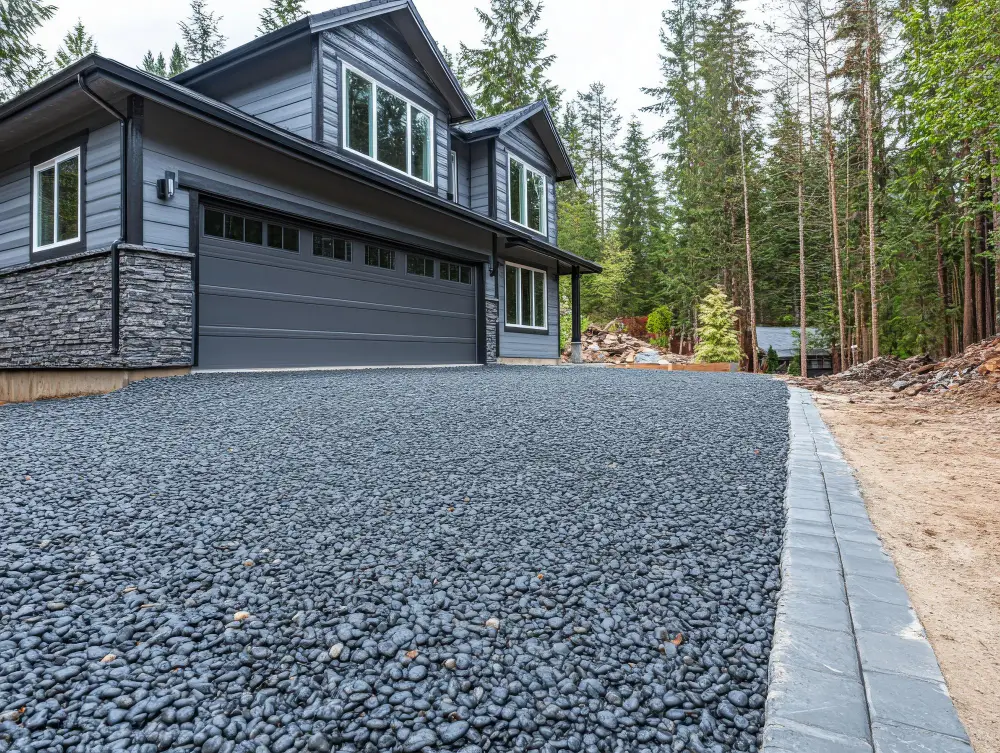
Gravel is the most economical surface to install, which is why it covers so many long rural and estate driveways. It handles length without a large bill, it drains well, and it fits the rural setting. Done right, with proper base layers and grading, a gravel driveway performs and looks like it belongs.
The cost shows up in upkeep. Gravel needs grading from time to time as the surface settles, it can wash on steeper grades without good drainage, and it needs occasional refreshing. So in the gravel vs asphalt driveway estate homes comparison, gravel wins on install cost and loses on maintenance. For a long drive where some upkeep is acceptable and the rural look is wanted, it is often the right call, especially for the long run-up to the home.
Asphalt
Asphalt sits in the middle on cost and gives a smooth, solid surface. It handles grade well, sheds water, and takes heavy use. For an estate that wants pavement without the cost of concrete across a long driveway, asphalt is the practical answer.
Asphalt asks for some attention over time. It needs sealing to hold up, and without a proper base it can soften in heat or crack with the freeze-thaw cycle. Installed correctly, on a real base with good drainage, it lasts well and gives a finished surface at a reasonable cost. In the gravel vs asphalt driveway estate homes comparison, asphalt is the middle ground, more finished and lower maintenance than gravel, less costly than concrete.
Concrete
Concrete is the most durable and the longest lasting of the three. It carries heavy loads without trouble, asks for little upkeep, and can be finished with texture or color so it reads as part of the property. For the areas that take the most use, near the home and the garage, concrete often makes sense even on a property that uses something else for the length.
The catch is cost. Concrete is the most expensive to install, which makes it a large number across a long estate driveway. This is why many estates use concrete where it matters most and a less costly surface for the long run. So while the gravel vs asphalt driveway estate homes question often comes down to those two for the length, concrete frequently earns the sections near the home where durability and finish carry the most weight.
How to Actually Choose
Rather than picking one surface for the whole driveway, the better approach on most estates is to match the surface to each section.
The long run-up, where length drives cost, often goes to gravel or asphalt depending on how much upkeep you want and how finished you want it to look. The areas near the home and garage, where use is heaviest and the approach is seen most, often justify concrete or pavers. This is the answer the gravel vs asphalt driveway estate homes comparison usually arrives at on a real property. It is not one surface against another. It is the right surface in each place, planned as one driveway.
The factors that tip the decision are length, grade, the look you want at the approach, and the upkeep you will accept. A steep drive changes the math toward surfaces and drainage that hold on grade. A long drive changes it toward economy for the run-up. A formal approach changes it toward a finished surface near the home.
The Work That Matters More Than the Surface
Here is the part that decides how long any of these surfaces lasts, and it is the same for all three. The base underneath and the drainage around it.
A driveway is only as good as the base it sits on. Proper layers, compacted correctly, are what keep any surface from settling and failing early. Skip the base and even concrete will fail. Drainage is the other half, because water is what destroys driveways, especially on a grade. The gravel vs asphalt driveway estate homes choice matters, but it matters less than the base and drainage under whichever surface you pick. The surface gets the attention. The base and drainage do the work.
Choosing for a Mountain Estate
In Western North Carolina, the grade, the water, and the freeze-thaw cycle push every one of these surfaces harder than they would face on flat ground.
Steep approaches are common, and they demand surfaces and drainage that hold on grade. The freeze-thaw climate works on gravel, asphalt, and concrete alike through the winter, which makes the base and drainage matter even more here. And the length of many mountain estate driveways makes the cost difference between surfaces real, which is why the section-by-section approach is so often the right one.
Because the driveway is infrastructure tied to grading and drainage, it is planned with the build, not added at the end. This is part of why the discovery phase begins before any design work. The driveway, the site work, and the utilities all line up with how the property is developed.
What People Usually Ask About
A few points come up whenever a driveway surface is the question.
Which Surface Is Best
There is no single best surface. Gravel wins on cost and rural character, asphalt on balance, concrete on durability and finish. The gravel vs asphalt driveway estate homes answer is usually a mix, with the right surface in each section of the drive.
Why the Base Matters More Than the Surface
Most failed driveways failed because of a poor base or bad drainage, not the surface material. A proper base and a real drainage plan are where the money is best spent, because they keep any surface intact over the years.
How the Driveway Fits the Larger Project
On an estate the driveway is part of the site work, tied to grading, drainage, and access. We handle it with the build rather than as a separate job, and we take a limited number of projects each year so each site gets that coordination. A private consultation comes before we schedule anything.
Choosing the Right Surface for the Right Place
The gravel vs asphalt driveway estate homes question rarely has a single answer, and that is the point. Gravel, asphalt, and concrete each have a place, and the best estate driveways use the right one in each section, built on a base and drainage that keep water from winning. Match the surface to the length, the grade, the use, and the look, and the driveway works for decades.
If you are building or improving an estate property in Western North Carolina, reach out for a private consultation. Tell us about your land and your approach, and we will walk through the right surfaces for the driveway your property actually needs.