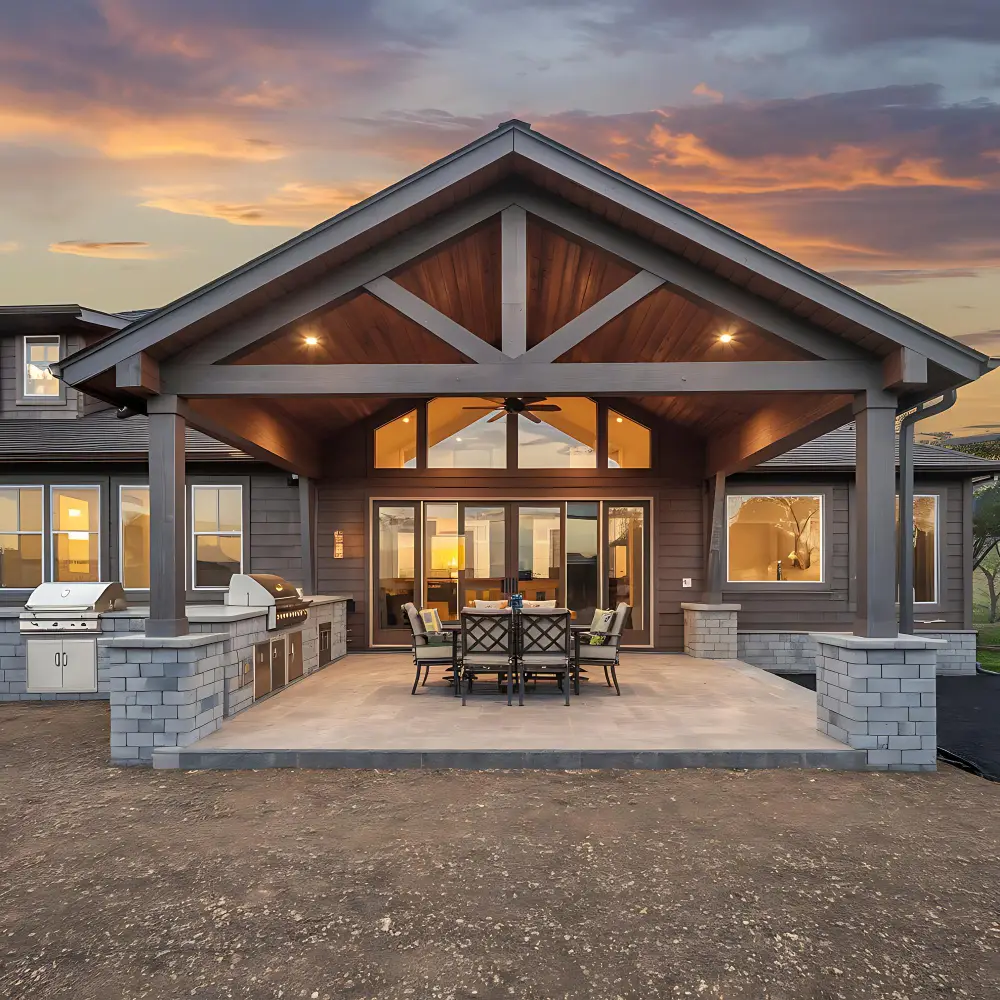
On a mountain property, the porch is often the room people use most. It is where the morning coffee happens, where the afternoon stretches out, where the view stops being something you look at through glass and becomes a place you sit in. For a lot of homes in the mountains, the covered porch is the reason the house faces the way it does.
That is exactly why it deserves to be designed with the home, not added to it afterward. A porch built as an afterthought looks like one. The proportions feel off, the roofline does not match, the connection to the house feels tacked on. A porch designed as part of the home reads as though the house was always meant to open onto it. The covered porch design mountain estates are built around starts at the drawing stage, with the porch treated as a room, because that is what it becomes.
If you are planning a home or an outdoor space in the mountains, here is how to think about getting the porch right.
Why the Porch Is a Room, Not an Add-On
The mistake people make is treating a porch like an accessory. Something to attach to the back of the house once the real design is done. That thinking is why so many porches feel separate from the homes they belong to.
A covered porch on a mountain estate is a living space. People spend real hours there, often more than in some of the indoor rooms. It has a relationship with the view, the light, the weather, and the rooms it connects to. The covered porch design mountain estates rely on treats it with the same care as any interior room, because it carries the same daily use. That means it gets planned for proportion, for flow, for comfort, and for how it sits against the house and the land.
When the porch is designed this way, the line between inside and outside softens. The indoor rooms open onto it naturally, the materials carry through, and the porch becomes part of how the whole home lives rather than a place you step out to.
The Elements That Make a Porch Work
A few decisions separate a porch people use every day from one they walk past. These are the ones that matter most in covered porch design mountain estates ask for.
Orientation & the View
The first decision is where the porch faces. A porch should be placed to catch the view that made the property worth buying, the light at the time of day you will use it most, and shelter from the weather that comes through. On a mountain lot, this ties directly to how the house sits on the land, which is why the porch and the home are planned together. Get the orientation right and the porch sells itself every time you walk onto it.
The Roof & How It Connects
A covered porch is defined by its roof, and the roof is where the connection to the house is made or lost. The roofline should follow the home, the materials should carry through, and the structure should read as one with the house rather than bolted to it. This is the difference people feel without naming. A porch roof that belongs looks like the house grew it. One that does not looks like a carport.
Proportion & Scale
A porch has to be sized for how it will be used and for the home it attaches to. Too small and it goes unused, because there is no room to actually live there. Too large and it overwhelms the house and feels empty. The covered porch design mountain estates depend on gets the proportions right, so the space feels generous and still belongs to the home it extends.
Materials Built for the Mountains
A covered porch takes weather that indoor rooms never see. Sun, rain, wind, and the freeze-thaw cycle all work on it year round. The materials have to handle that without constant upkeep. Decking, ceiling, structure, and finishes all get chosen for how they hold up to mountain conditions, so the porch stays sound and good-looking without becoming a maintenance chore. On a property meant to be lived in rather than fussed over, that durability is part of the design.
Comfort That Extends the Seasons
The best porches get used most of the year, and that takes planning. An outdoor fireplace or heater pulls the porch into the cooler months. Fans and shade handle the warm ones. Lighting makes the space work after dark. Screening keeps the insects out on summer evenings. Each of these stretches the porch beyond fair-weather afternoons into a space that earns its place across the seasons.
The Floor Underfoot
The decking gets walked on every day, so it deserves real thought. On a mountain porch it takes sun, rain, and the freeze-thaw cycle, and it has to stay sound and sure-footed through all of it. The material sets the feel of the space and the upkeep it will ask for over the years. Choosing it well, in coordination with the rest of the porch, is part of the covered porch design mountain estates lean on, because the floor is the part of the porch people are always in contact with.
Designing for the Mountain Setting
In Western North Carolina, the setting shapes the porch as much as the house does.
The view is usually the reason the property exists, so the porch is often the spot the entire home orients toward. Mountain weather means the porch has to handle rain, wind, and winter, which puts real weight on the roof, the structure, and the materials. And the slope of the lot affects where the porch can sit and how it relates to the grade, which is one more reason the covered porch design mountain estates use is planned with the site from the start.
Because the porch ties into the home, the roof, and the site work all at once, it is designed as part of the build rather than as a later addition. This is part of why the discovery phase begins before any design work. The porch, the house, and the land all have to be read together for the porch to land where it belongs.
What People Usually Ask About
A few points come up whenever a porch is part of the plan.
Designing the Porch With the Home
A porch planned with the house from the start always reads better than one added later. The proportions match, the roofline connects, and the materials carry through. Adding a porch after the fact can work, but it rarely feels as natural as one that was part of the design from the beginning.
Getting Year-Round Use
A porch can be a three-season or near year-round space with the right planning. Heat for the cold months, shade and air for the warm ones, lighting for the evenings, and screening where insects are an issue. These choices are easiest to build in from the start, when the structure and systems can be planned around them.
How the Process Begins
It begins with reading the land and the home together, so the porch can be placed for the view, the light, and the weather. We take a limited number of projects each year, so each one gets that attention, and a private consultation comes before we schedule anything.
A Porch That Earns Its Place
On a mountain estate, the covered porch is often the room that defines the home. It is where the view becomes a place to sit, where the seasons get spent, where the house opens to the land around it. The covered porch design mountain estates are built around treats it as exactly that, a room, designed with the home and the site so it belongs to both.
If you are planning a home or an outdoor living space in Western North Carolina, reach out for a private consultation. Tell us about your property and how you want to live on it, and we will walk through a porch built to be the part of the home you use most.