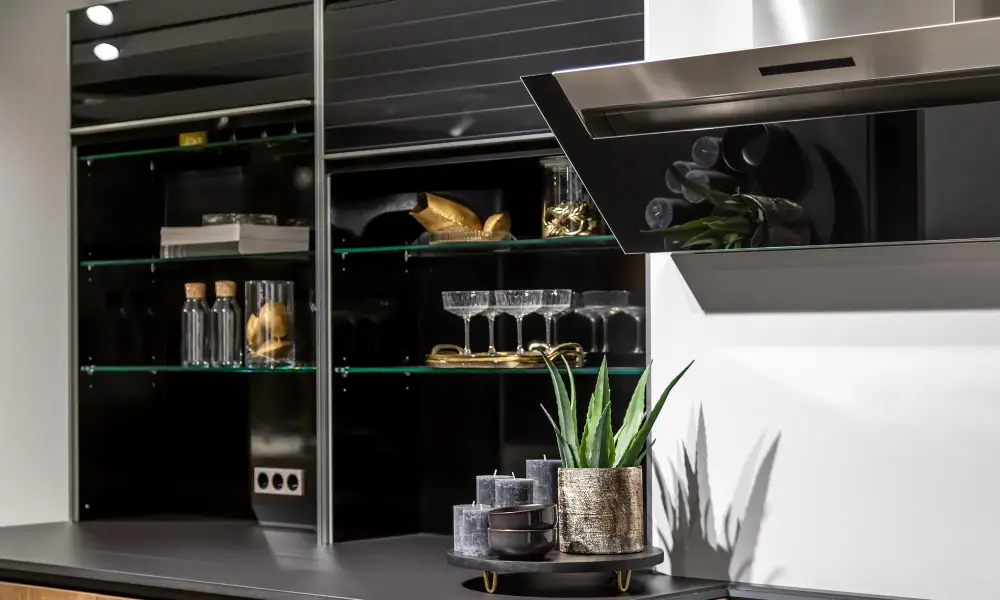
The luxury cabinetry trends 2026 is producing in the Western NC market reflect a maturation of taste after a decade of shifting styles. The all-white kitchen, which dominated the luxury renovation market for years, has given way to more material-specific, regionally connected approaches. The farmhouse-shaker hybrid that production builders adopted and overexposed has been replaced, at the luxury level, by cabinet design that responds to the specific architectural character of the home it lives in.
What is happening in the luxury kitchen cabinetry market in 2026 is less about trend-chasing and more about specification discipline, the return to material quality, construction method, and design integration as the primary value propositions.
The Move Toward Dark Painted & Natural Finishes
The single most consistent shift in luxury cabinetry trends 2026 is the move away from white and light gray toward dark painted finishes and natural wood expressions. Charcoal, deep green, warm black, and navy, used on perimeter cabinetry, on islands, or on specific accent pieces within the kitchen, are appearing consistently in the luxury mountain home market in Weaverville and across Western NC.
This shift is not arbitrary. Dark field colors work against the natural light that south-facing mountain kitchens receive, creating a visual grounding in the space that white cabinetry, which tends to recede or flatten in strong natural light, does not produce. They also read well against the natural stone countertops and the exposed timber structural elements that characterize the mountain home interiors where these kitchens live.
Natural wood finishes, white oak, walnut, and occasionally cerused or wire-brushed finishes that bring out the grain texture, are the counterpart to the dark painted palette. The two-tone kitchen, with a dark painted lower cabinet and a natural wood upper cabinet or open shelving program, is one of the most consistent expressions of the current luxury cabinetry design register.
Inset Door Construction as the Quality Marker
The construction method of the cabinet, specifically the relationship between the door and the face frame, is the detail that most clearly distinguishes luxury cabinetry from premium production cabinetry in the 2026 market.
Inset door construction, where the door sits flush within the face frame rather than overlaying it, requires tolerances in fabrication and installation that overlay construction does not. The gap around an inset door is typically three thirty-seconds of an inch on all sides, a dimension that requires precision in the cabinet box, precision in the face frame, and precision in the door itself, all of which must be maintained through the delivery and installation process.
At the specification level luxury mountain kitchens in the Weaverville area are built to, inset door construction is the construction method that reflects the investment the project showcases. The visual flatness and the material density of an inset face-frame cabinet installed with consistent reveals reads as a different quality register than overlay construction, and it is, because the fabrication standard required to produce it is higher.
Open Shelving as a Design Element
Open shelving, floating shelves in white oak, walnut, or blackened steel, appears in the luxury cabinetry trends 2026 luxury kitchens are expressing most clearly as an intentional design element rather than as a cost-saving substitution for upper cabinet boxes.
In a mountain kitchen where the design intent is to connect the interior material palette to the structural and natural elements of the home, open shelving provides the opportunity to display regional ceramics, glassware, and cookware as part of the kitchen’s visual program. It also lightens the upper portion of the kitchen visually, in kitchens with high ceilings and strong natural light, solid upper cabinet boxes can feel heavy and close in a space that the architecture is working to open.
The construction consideration with open shelving is the wall preparation beneath the shelves. Open shelves carry concentrated loads at their bracket points, loads that must bear into the wall structure, not just into drywall. The bracket type, the blocking required in the wall framing, and the wall finish behind the shelves are all details that must be addressed before the shelves are installed.
Integrated Appliance Programs
The luxury cabinetry trends 2026 kitchen programs in the Western NC market are reflecting a strong preference for integrated appliance panels, refrigerators, dishwashers, and in some cases oven warming drawers, behind cabinet door panels that match the surrounding cabinetry.
The integrated appliance approach requires cabinetry and appliance specification to be coordinated in the design phase. The appliance model determines the panel dimensions and the hinge configuration that the cabinetry must accommodate. Specifying the cabinetry before the appliances are selected, a common sequencing mistake, produces a program where the integration detail does not work as designed.
In mountain kitchens where the design intent is to subordinate the appliances to the overall material expression of the space, the integrated panel approach produces a result that the revealed stainless appliance approach does not, a kitchen where the cabinetry program reads as a coherent material expression rather than a backdrop for appliances.
Localized Advice
The luxury cabinetry trends 2026 luxury mountain kitchens in the Weaverville area are incorporating require lead times that must be built into the project procurement schedule. Full custom cabinetry from a shop working at this specification level runs twelve to sixteen weeks from approved shop drawings to delivery. That lead time means the cabinet specification must be finalized in the design phase, before construction begins, and the order must be placed with enough lead time that delivery coincides with the installation window in the construction schedule.
Discovery phase begins before design and private consultations are required before any project is scheduled. The number of annual kitchen renovation and new construction projects accepted is limited to ensure every cabinetry specification decision is made with full design coordination.
FAQ
What is the difference between custom & semi-custom cabinetry at the luxury level?
Full custom cabinetry is produced to any dimension in any configuration, no standard module sizes, no catalog limitations. Semi-custom cabinetry modifies standard cabinet boxes within a limited range of dimensions and configurations. At the luxury level in a mountain home kitchen, full custom cabinetry is the appropriate specification, the kitchen dimensions and the design program of the space are too specific to accommodate the constraints that semi-custom imposes.
How do I maintain dark painted cabinet finishes in a mountain kitchen?
Dark painted finishes show fingerprints and water marks more readily than lighter finishes. Matte and eggshell sheens are more forgiving in this regard than satin or semi-gloss. Regular cleaning with a damp cloth and a mild cleaning solution maintains dark painted cabinetry without damaging the finish. Touch-up paint matched to the original finish addresses the chips and marks that occur over years of use.
Should island cabinetry match perimeter cabinetry or contrast it?
Both approaches are appropriate in 2026 luxury kitchen programs. A contrasting island, different color or different material from the perimeter cabinets, reads as a furniture piece within the kitchen space. A matching island reads as part of a unified program. The choice depends on the overall design intent and the size of the kitchen, in smaller kitchens, a matching program often reads better; in larger kitchens, the contrast adds spatial interest.
Specify the Cabinetry Before You Frame the Kitchen
The luxury cabinetry trends 2026 luxury kitchens require start with design decisions made before construction begins. Limited annual projects are available. Private consultations are required before any project is scheduled.
Request Your Private Consultation → Start Your Discovery Phase → Discuss Your Project →