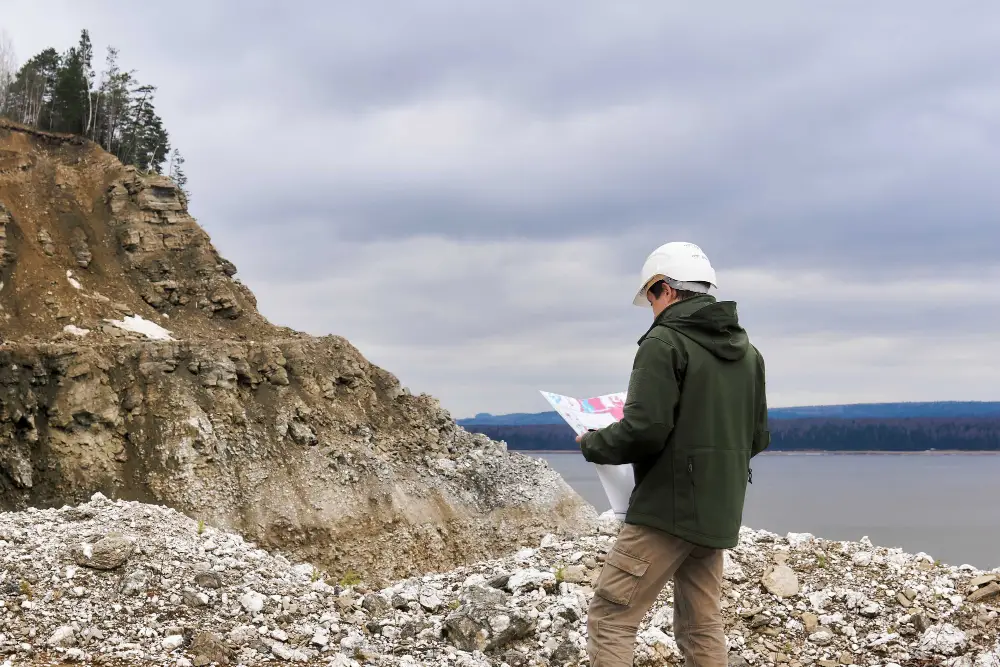
Weaverville Mountain Lot Challenges Explained
The appeal of a mountain lot in the Weaverville area is immediately apparent to anyone who has spent time on one. The elevation, the views, the natural separation from neighboring development, the sense of arrival that a home positioned in the terrain delivers, these are the qualities that draw clients to private land in northern Buncombe County and keep them committed to building there even after they understand what building on that land actually requires.
What those clients need before they purchase a parcel and commit to a construction program is an accurate understanding of the Weaverville mountain lot building challenges that will shape the project from the first site assessment through the day construction is complete. Not to be discouraged from the undertaking, mountain lot construction in this region, executed with the right firm and the right process, produces homes that cannot be replicated on flat ground, but to approach it with the preparation the site conditions demand.
This guide covers the primary building challenges specific to mountain lots in the Weaverville area: what they are, why they matter, and how they are addressed by a firm with the design-build experience and regional site knowledge to manage them from the outset of the project.
Challenge One: Slope Grade & Site Preparation
The most immediate Weaverville mountain lot building challenge for most clients is slope. The parcels in the Weaverville area that deliver the views and the privacy clients are building toward are, by definition, the parcels that occupy elevated terrain, and elevated terrain in the southern Appalachians comes with slope grades that range from manageable to genuinely demanding.
Slope grade affects almost every cost and schedule element of a mountain lot construction project. It determines how much cut-and-fill work the building pad requires. It determines the foundation type the structure needs. It governs the driveway design and the grades that the access road must achieve to be navigable year-round in Western North Carolina’s winter conditions. It affects where the septic system can be installed relative to the building footprint. And it determines how much of the total project budget goes into site work before a single structural element of the home is erected.
On a gently sloping parcel, grades under ten percent, site preparation costs are relatively modest and the foundation options are broad. On a moderately sloped parcel, ten to twenty-five percent grade, cut-and-fill volumes increase meaningfully, foundation engineering requirements become more specific, and driveway design requires careful attention to grade and drainage. On steep parcels above twenty-five percent grade, site preparation costs can represent a significant fraction of the total project budget, foundation systems require full geotechnical engineering, and driveway design may require retaining walls or switchback routing to achieve grades that work year-round.
The slope of a specific parcel in the Weaverville area must be documented through a topographic survey and assessed by the project team before a construction program and budget are committed to. The visual impression of a slope from the road or from a site walk without measurement instruments is consistently less reliable than the surveyed grade data, and the difference between a twelve percent slope and a twenty-two percent slope is a significant construction cost difference that must be understood before the land purchase is finalized.
Challenge Two: Geotechnical Conditions
The geology of the Weaverville area reflects the ancient structure of the southern Appalachians, a terrain of metamorphic and igneous rock overlain with residual soils that vary significantly in depth, bearing capacity, and drainage characteristics across short horizontal distances. What this means for a mountain lot construction project is that the soil conditions beneath a parcel’s surface are not uniform and cannot be assumed without investigation.
Rock shelf at shallow depths, a common condition on steeper Weaverville-area parcels, complicates foundation excavation and increases the cost of foundation installation when the rock must be broken or blasted rather than excavated with conventional equipment. It also affects drainage routing beneath the structure and the placement of utility trenches that must achieve minimum depth requirements regardless of what the ground beneath them contains.
Clay-bearing subsoils, common in the lower slope positions and valley-adjacent areas of the Weaverville area, expand when wet and contract when dry, a behavior pattern that creates differential movement in foundations that are not designed specifically for those conditions. The bearing capacity of clay-bearing soils is also lower than granular soils and must be accounted for in foundation sizing.
The appropriate response to geotechnical uncertainty on a Weaverville mountain lot is a geotechnical investigation, soil borings or test pits that produce documented information about the bearing conditions, the depth to rock, and the soil classification beneath the proposed building site, completed in the design phase before foundation engineering is finalized. That investigation is an investment in the accuracy of the foundation design and in the reliability of the construction cost estimate, both of which are worth more than the cost of the investigation itself.
Challenge Three: Drainage & Water Management
Seasonal water movement on mountain lots in the Weaverville area is a building challenge that affects the site preparation, the foundation design, the retaining wall engineering, and the long-term performance of the finished structure. The southern Appalachians receive significant annual precipitation, typically fifty to sixty inches per year in the Weaverville area, delivered across seasonal patterns that produce periods of sustained ground saturation followed by drier periods that mask the drainage conditions the site must manage at peak load.
Surface water management on a sloped parcel begins with site grading that directs surface runoff away from the building footprint and toward established drainage paths rather than allowing it to pool against the foundation or saturate the soil behind retaining walls. Subsurface drainage, french drains, foundation perimeter drains, and engineered drainage systems beneath and around the structure, addresses the groundwater movement that surface grading alone cannot intercept.
Retaining walls on Weaverville mountain lots that are not designed with adequate drainage behind them are the most consistent source of structural failure in site work on sloped properties in this region. The hydrostatic pressure generated by water accumulating behind an undrained wall carries loads the wall was not designed to carry and produces movement that becomes visible within years of construction. Drainage engineering is not an optional supplement to retaining wall design, it is a primary structural component that must be addressed in the design documentation before construction begins.
For clients evaluating a specific Weaverville-area parcel, the drainage patterns of the site during and after a significant rain event are among the most informative site observations available. A site visit following a period of sustained precipitation reveals drainage behavior that a dry-day site walk does not.
Challenge Four: Driveway Design & Access
Access to a mountain lot in the Weaverville area involves design decisions that directly affect how the property functions across decades of use, not just how the construction period is managed. The driveway from the public road to the building site must achieve grades that are navigable in winter conditions, provide adequate sight distance at the road connection point, accommodate the turning radius of the vehicles that will use it, and manage surface drainage without eroding the road base.
Maximum practical driveway grades for year-round residential use in Western North Carolina’s climate, where ice and snow conditions occur seasonally at the elevations common to Weaverville-area mountain lots, are generally considered to be in the range of twelve to fifteen percent for paved surfaces and somewhat lower for gravel. Grades above that range create traction conditions in winter that limit safe access and frequently damage vehicles attempting to navigate them.
Driveway routing on a sloped parcel that achieves an acceptable grade from the road to the building site sometimes requires switchback routing, cut-and-fill operations that extend the driveway significantly beyond the straight-line distance between the road and the building pad, or retaining walls along the driveway corridor to maintain the road grade while managing the slope above and below it. All of these conditions add to the driveway construction budget and must be assessed as part of the site evaluation before the building site is selected and the construction program is budgeted.
The driveway is also the access route for construction equipment and material deliveries throughout the build period. A driveway that works for residential vehicles but cannot accommodate a concrete truck, a lumber delivery, or a crane positioned for framing operations creates schedule constraints and potential additional costs during construction that should be identified and addressed before the project begins.
Challenge Five: Utility Installation on Mountain Terrain
Most private mountain lots in the Weaverville area require private well and septic systems, municipal water and sewer connections are not available on most of the private acreage in northern Buncombe County outside the immediate town center. Installing those systems on sloped terrain introduces conditions that flat-land utility installation does not encounter.
Well drilling on a sloped mountain lot requires equipment access to the drill site and a drilling depth that may be greater than what lower-elevation parcels in the region require. The aquifer conditions beneath Weaverville-area mountain lots vary, and the depth required to achieve adequate water yield is not predictable with certainty before drilling begins. Well costs in this area range from $8,000 to $20,000 or more depending on the depth and the yield achieved.
Septic system placement on a sloped lot must satisfy setback requirements from the well, the property boundaries, the stream buffers, and the building footprint, and must achieve the soil absorption conditions the system design requires in an area of the parcel that satisfies all of those constraints simultaneously. On steep or heavily wooded parcels, the area of ground that satisfies all of these conditions simultaneously may be limited, and the septic system design may need to account for alternative absorption methods that work in the available area.
Electrical service routing on mountain lots, from the utility company’s point of delivery to the home’s service entrance, may involve underground trenching across sloped terrain, coordination with the utility company on service routing, and in some cases the installation of a transformer pad if the service distance from the nearest distribution line is significant.
Challenge Six: Construction Logistics on Sloped Sites
The physical logistics of building on a mountain lot in the Weaverville area present operational challenges that flat-land construction does not encounter. Equipment positioning for foundation excavation, concrete placement, framing, and roofing on a site with significant slope requires planning that accounts for the grade, the load-bearing capacity of the ground where equipment must be positioned, and the access constraints of the specific site.
Concrete placement for a foundation on a steep lot may require a concrete pump if the delivery truck cannot reach the pour location directly. Framing materials delivered to a steep site may require additional handling between the delivery point at road grade and the building platform above it. These are not unusual conditions for a firm with genuine mountain site construction experience, but they are conditions that must be anticipated and priced in the pre-construction phase, not discovered during construction.
The construction timeline on mountain lots in the Weaverville area is also affected by weather conditions at elevation. Winter work on steep sites introduces ice and frost conditions that affect equipment operation, concrete placement windows, and the safety of workers on sloped ground. A realistic construction schedule for a mountain lot project accounts for these conditions and does not assume that the construction period will proceed at the same pace as a flat-site build regardless of season.
Localized Advice for Weaverville Mountain Lot Buyers
The Weaverville mountain lot building challenges outlined in this guide are not arguments against building on mountain terrain in this region. They are the conditions that produce homes worth building, homes whose relationship to the terrain, whose views, and whose presence in the natural setting cannot be achieved without accepting and managing the demands the terrain places on the construction process.
What they require is a firm with the site assessment discipline to document these conditions before the project is priced, the engineering capacity to address them in the design phase, and the construction experience to manage them through the build. Black Rabbit Construction has operated on Weaverville-area mountain lots for over two decades and accepts a limited number of projects each year to maintain the standard that this type of work demands.
Discovery Phase consultations are available for clients evaluating specific mountain lot parcels in the Weaverville area. That consultation is the most efficient first step toward understanding what a specific site requires before a land purchase or a construction commitment is made.
FAQ
How do I know if a mountain lot in Weaverville is too steep to build on practically?
Slope grade above approximately thirty-five to forty percent begins to create site preparation and foundation costs that can approach or exceed the construction cost of the home itself on parcels of modest size. The practical upper limit for cost-effective luxury custom home construction depends on the specific site conditions, the program size, and the client’s budget for site work. A site assessment by an experienced design-build firm is the most reliable way to evaluate a specific parcel’s buildability at the intended specification level.
Can a steep Weaverville mountain lot qualify for a conventional mortgage or construction loan?
Lenders evaluate mountain lot construction loans based on the appraised value of the completed project relative to the total project cost, including all site work and infrastructure. Parcels with very high site development costs relative to the finished home value can create loan-to-value conditions that some lenders are not comfortable with. This is a conversation to have with a construction lender early in the planning process.
Does Black Rabbit assess mountain lot conditions before a land purchase is finalized?
Yes. The Discovery Phase is specifically structured to provide site assessment input for clients who are evaluating parcels before a purchase commitment is made. This is one of the most valuable applications of the Discovery Phase consultation and one of the most consistently underutilized steps in the mountain lot purchase process.
How does rock shelf beneath a Weaverville mountain lot affect foundation cost?
Rock shelf at shallow depth requires blasting or mechanical breaking rather than conventional excavation, which adds cost and time to the foundation phase. It also affects drainage routing beneath and around the structure. The depth to rock on a specific parcel is confirmed through geotechnical investigation, test pits or soil borings, completed in the design phase before foundation engineering is finalized.
Know What Your Lot Requires Before You Commit to It
The Weaverville mountain lot building challenges that determine a project’s site development cost and construction timeline are identifiable before a land purchase is made, if the right assessment process is applied at the right time. Black Rabbit Construction’s Discovery Phase provides that assessment and accepts a limited number of consultations each year.
Request Your Private Consultation → Start Your Discovery Phase → Discuss Your Project →